

Indoor vs Outdoor Swimming Pools in India: Cost, Design & Maintenance
Olympic Swimming Pool Dimensions: Official Size, Depth & Standards Explained

If you’re searching for Olympic swimming pool dimensions, you’re likely planning, designing, or evaluating a competition-level swimming facility. Olympic pools follow strict international standards to ensure fair competition, athlete safety, and accurate timing and even small deviations can make a pool ineligible for official events.
In this guide, we explain the exact dimensions of an Olympic-size swimming pool, including length, width, depth, lane markings, water temperature, and governing standards. Whether you’re building a sports complex, school, academy, or professional swimming facility, this article covers everything you need to know.
Official Olympic Swimming Pool Dimensions
1. Pool Length
50 metres
Measured between the touchpads at each end
Tolerance: very minimal (strict compliance required)
This is why Olympic pools are also called long-course pools.
2. Pool Width
25 metres
The width allows for:
10 lanes, each 2.5 metres wide
8 competition lanes + 2 outer buffer lanes
3. Number of Lanes
10 total lanes
Lane width: 2.5 metres
Competition lanes: Lanes 1–8
Outer lanes: Lanes 0 and 9 (wave reduction & safety)
4. Pool Depth
Minimum depth: 2.0 metres
Recommended depth: 3.0 metres or more for elite competition
Greater depth:
Reduces wave reflection
Improves swimmer performance
Enhances safety during starts and turns
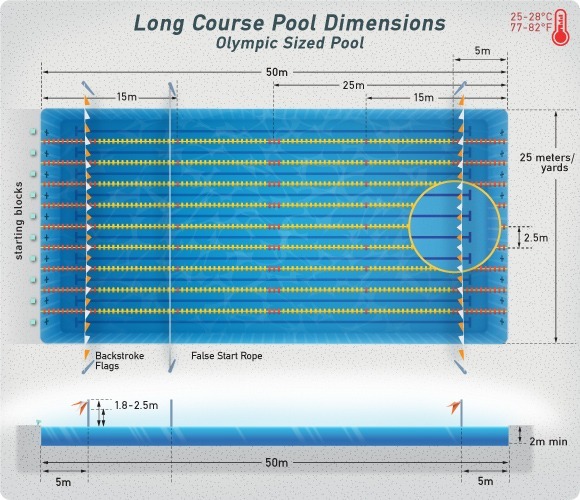
Exact Olympic Swimming Pool Dimension
| Feature | Official Dimension |
|---|---|
| Length | 50 metres |
| Width | 25 metres |
| Depth | Minimum 2.0 m (recommended 3.0 m) |
| Number of lanes | 10 |
| Lane width | 2.5 metres |
| Total water volume | ~2.5 million litres |
Lane Markings & Pool Markings
Precise markings ensure fair competition and visibility:
Black centre line along each lane
T-shaped marking at both ends
Lane ropes designed to absorb wave energy
Colour-coded lane ropes for official events
These markings must follow exact spacing and contrast guidelines.
Starting Blocks & Touchpads
Olympic pools use professional equipment:
Starting blocks mounted at each lane
Adjustable footrests for track starts
Electronic touchpads at both ends for timing accuracy
Integrated with automatic timing systems
Water Temperature & Quality Standards
Water conditions are tightly controlled:
Temperature: 25°C – 28°C
Uniform circulation across all lanes
High-clarity water for visibility
Advanced filtration and disinfection systems
Why Olympic Pool Dimensions Matter
Correct dimensions are essential because they:
Ensure fair competition
Allow accurate timing and records
Improve athlete safety
Meet international certification requirements
Enable hosting of national & international events
Even small deviations can disqualify a pool from official use.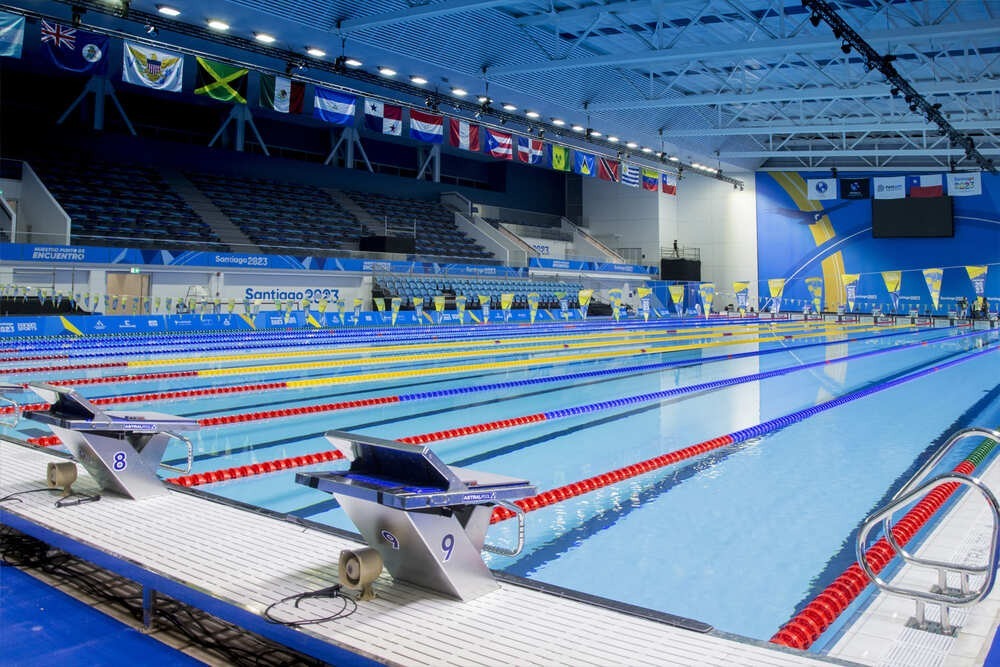
Difference Between Olympic Pool vs Semi-Olympic Pool
Many facilities opt for semi-Olympic pools due to space or budget constraints.
| Feature | Olympic Pool | Semi-Olympic Pool |
|---|---|---|
| Length | 50 m | 25 m |
| Width | 25 m | 12.5 m |
| Lanes | 10 | 6 |
| Usage | International competitions | Training & local events |
Who Should Build an Olympic-Size Pool?
Olympic swimming pools are typically built for:
Sports authorities & federations
Professional training academies
University campuses
High-performance sports centres
National & international competition venues
For schools, residential projects, or hotels, custom or semi-Olympic pools are usually more practical.
Build Olympic-Standard Swimming Pools with Michezo Sports Infra
Michezo Sports Infra specialises in designing and constructing competition-grade swimming pools that meet international performance and safety standards. From technical planning and waterproofing to filtration, finishes, and commissioning, our team delivers end-to-end swimming pool solutions across India.
Disclaimer
The dimensions and standards mentioned above are based on international competition guidelines. Actual pool design, construction details, and specifications may vary depending on site conditions, governing authority requirements, intended usage, and project scope. Final dimensions should always be confirmed through detailed technical drawings and approvals before construction.