

Olympic vs Semi-Olympic Swimming Pools in India: Size, Use & Planning
Commercial vs Residential Swimming Pools: Key Differences You Should Know Before Building

Planning to build a swimming pool? One of the first and most important decisions you’ll need to make is whether your project falls under a commercial swimming pool or a residential swimming pool.
While both may look similar on the surface, commercial and residential swimming pools differ significantly in terms of design standards, construction methods, safety requirements, equipment, maintenance, and cost. Choosing the wrong approach can lead to compliance issues, higher operating costs, or long-term performance problems.
In this guide, we break down the difference between commercial and residential swimming pools to help you choose the right solution for your project.
What Is a Residential Swimming Pool?
A residential swimming pool is built for private use, typically within:
Individual homes or villas
Farmhouses
Private bungalows
Gated villa communities (limited access)
These pools are designed for low to moderate usage, focusing on comfort, aesthetics, and personal recreation rather than high bather loads.
What Is a Commercial Swimming Pool?
A commercial swimming pool is intended for public or semi-public use and must comply with stricter safety and operational standards.
Common examples include pools at:
Hotels & resorts
Apartment complexes
Schools & colleges
Sports academies
Clubs & public facilities
Commercial pools are designed to handle high user frequency, heavy wear, and regulatory oversight.
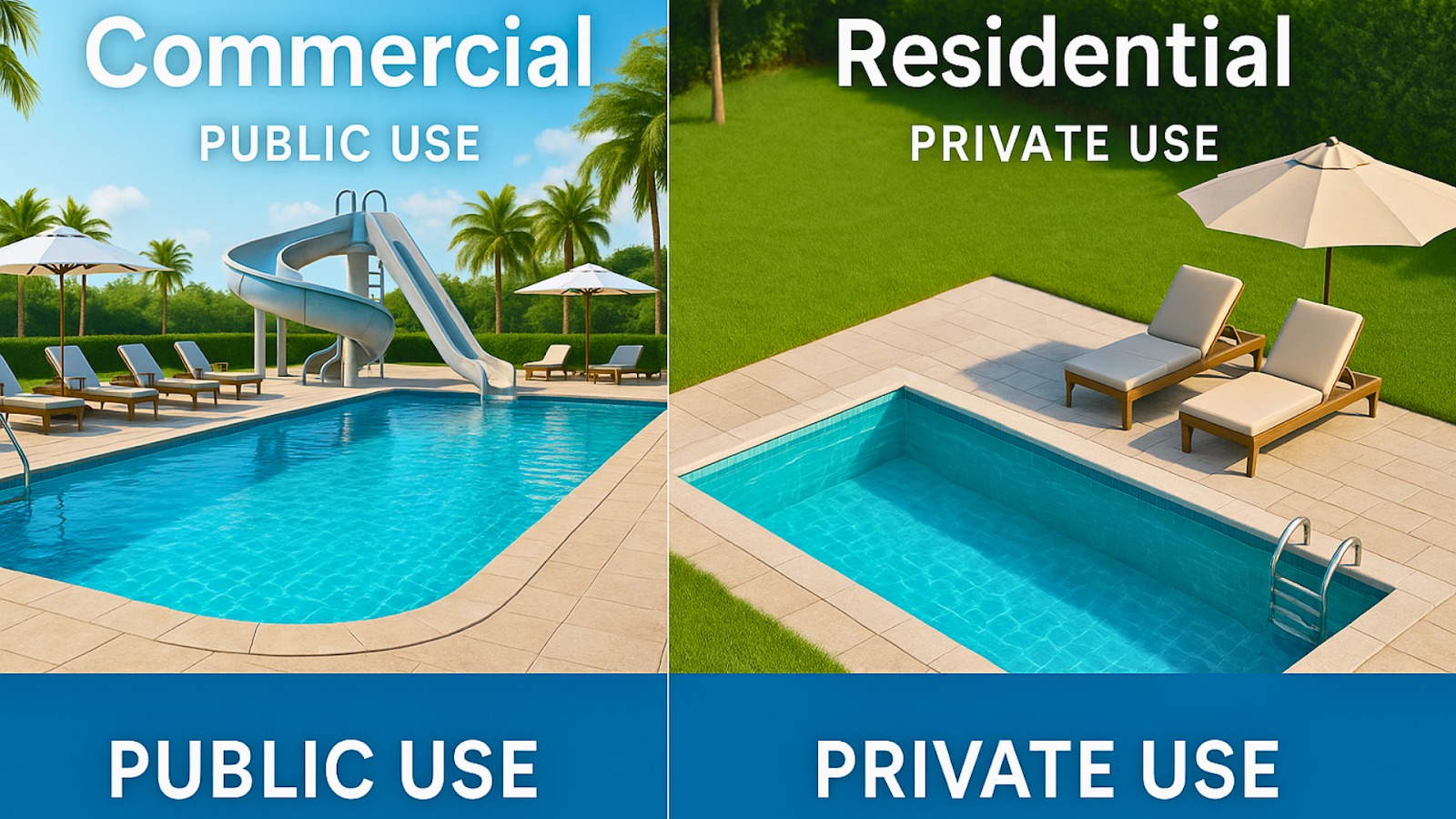
Commercial vs Residential Swimming Pools: Key Differences
1. Usage
Residential pools: Limited users (family & guests)
Commercial pools: High and continuous user load
Higher usage require stronger filtration, circulation, and disinfection systems.
2. Design & Size Flexibility
Residential pools:
Highly customisable shapes and depths
Designed around available space and aesthetics
Commercial pools:
Governed by regulations and safety norms
Standardised depths, steps, and access points
3. Safety & Compliance Requirements
Commercial swimming pools must comply with local authority guidelines and safety standards, which may include:
Non-slip finishes
Multiple entry/exit points
Lifeguard visibility zones
Safety signage
Emergency equipment
Residential pools generally have fewer mandatory compliance requirements.
4. Filtration & Water Treatment Systems
This is one of the biggest differences.
Residential pools:
Smaller pumps and filters
Manual or semi-automatic chlorination
Commercial pools:
High-capacity filtration systems
Advanced disinfection (chlorine dosing, UV, or ozone)
Continuous water circulation and monitoring
Commercial pools are designed to maintain water quality even during peak usage.
5. Construction Standards
Residential pools:
Can use lighter construction systems
Greater flexibility in finishes and materials
Commercial pools:
Heavier structural design
More robust waterproofing systems
Durable finishes to withstand constant use
6. Operating & Maintenance Requirements
Residential pools:
Lower chemical consumption
Lower electricity usage
Simple maintenance routines
Commercial pools:
Daily water testing
Higher chemical and power consumption
Trained maintenance staff or operators
7. Cost Differences
| Aspect | Residential Pool | Commercial Pool |
|---|---|---|
| Construction cost | Lower | Higher |
| Equipment capacity | Standard | Heavy-duty |
| Compliance costs | Minimal | Mandatory |
| Maintenance cost | Low–moderate | High |
Commercial pools cost more upfront but are designed for long-term, high-usage performance
Build the Right Swimming Pool with Michezo Sports Infra
At Michezo Sports Infra, we design and execute both residential and commercial swimming pools, tailored to usage, compliance needs, and long-term performance. From private villas to large public facilities, our team delivers end-to-end swimming pool construction solutions across India.
👉Not sure whether your project is commercial or residential?
Connect with Michezo Sports Infra for expert guidance, site evaluation, and the right construction strategy.
Disclaimer
The classification, design standards, and construction requirements discussed above are for general guidance only. Actual swimming pool specifications may vary based on local regulations, project usage, site conditions, and governing authority requirements. Final design and execution should be confirmed through detailed technical planning and approvals.