Cost of Basketball Court Construction in India: Everything You Should Know Before You Start
Basketball Court Dimensions in Metres: FIBA Size and Markings

Basketball court dimensions in metres are simple to remember for a FIBA court: 28 m long and 15 m wide, with the rim at 3.05 m, a 6.75 m three-point line and a key 4.90 m wide. All lines are 5 cm wide. This guide covers the full court, the key and three-point markings, half and school courts, run-off, ceiling height and how to mark a court correctly for Indian schools, clubs and housing societies.
If you are planning a court, our basketball court construction service covers the base, surfacing, markings, hoops and lighting from start to finish.
FIBA full court size
A FIBA basketball court is 28 m long and 15 m wide, a playing area of 420 sq m. The NBA court is slightly larger at 28.65 m by 15.24 m (94 × 50 ft), so check which standard your project follows. In India, most competitive and school courts follow FIBA rules.
Measurement | FIBA | NBA |
|---|---|---|
| Court length | 28m | 28.65m |
| Court width | 15m | 15.24m |
| Three-point line (arc) | 6.75m | 7.24m |
| Three-point line (corners) | 6.6.0m | about 6.70m |
| Key (lane) width | 4.90m | 4.88m |
| Free-throw line to backboard | about 4.60m | 4.57m (15 ft) |
| Rim height | 3.05m | 3.05m |
| Line width | 5 cm | 5cm |
Other key FIBA figures:
Diagonal: about 31.76 m, which is useful for checking the court is square when you set it out.
Backboard: 1.80 m wide by 1.05 m high.
Rim: 3.05 m from the floor to the top edge of the ring.
Centre circle: 3.60 m in diameter (1.80 m radius).
Key, 3-point line and free-throw markings
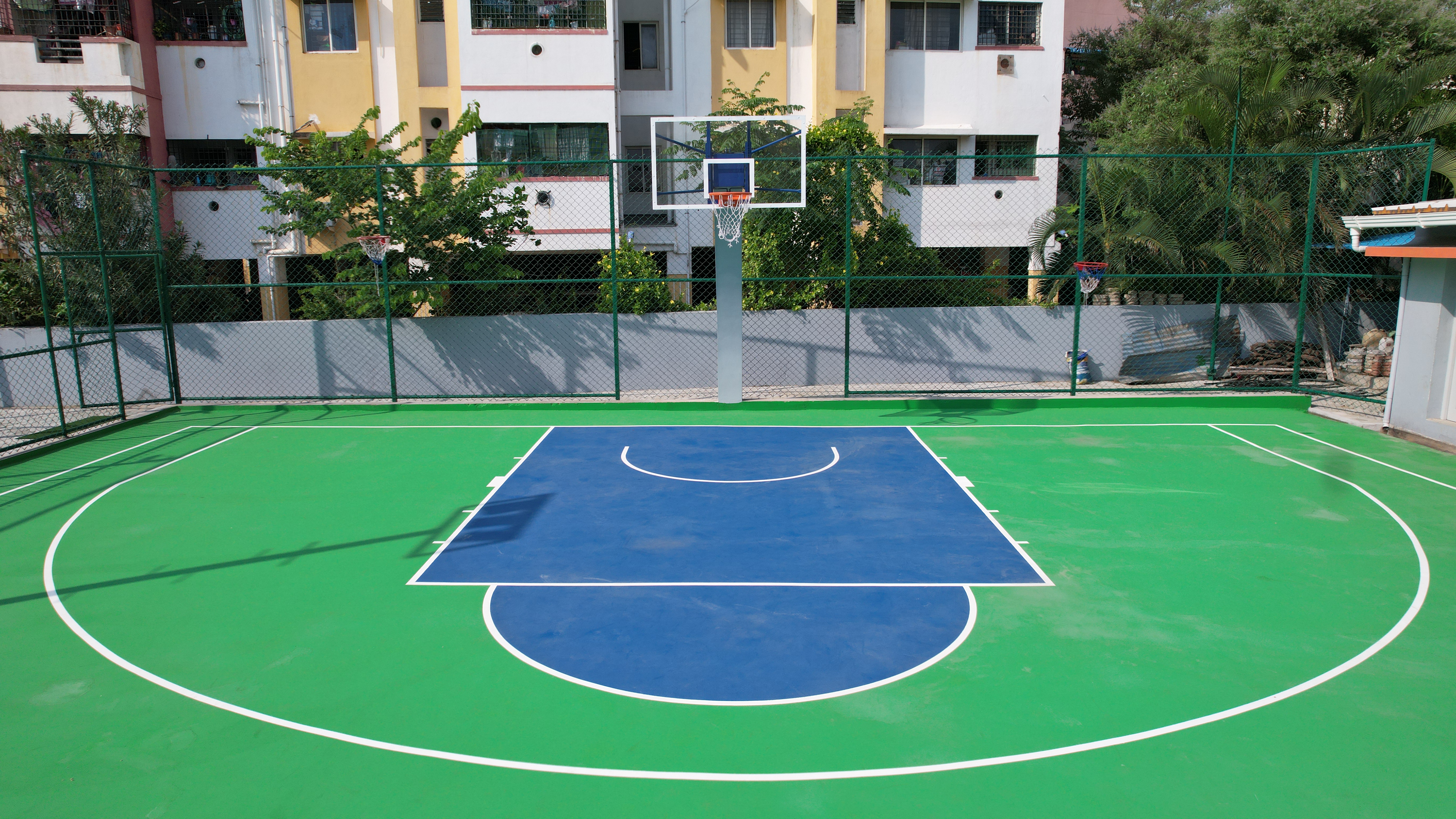 The key is a rectangle 4.90 m wide that runs from the end line to the free-throw line, and the free-throw line is 5.80 m from the inner edge of the end line. The three-point line is an arc with a 6.75 m radius from the point on the floor below the ring, joined to two straight lines that sit 0.90 m inside each sideline. In the corners, that makes the shortest distance 6.60 m.
Marking | Dimension (FIBA) |
|---|---|
Key (restricted area) width | 4.90 m |
Free-throw line | 5.80 m from the inner edge of the end line (about 4.60 m from the backboard face) |
Free-throw semicircle | 1.80 m radius, centred on the midpoint of the free-throw line |
No-charge semicircle | 1.25 m radius, under the basket |
Three-point arc | 6.75 m radius from the point on the floor below the ring |
Three-point straight lines | 0.90 m from each sideline (6.60 m shortest distance in the corners) |
Centre circle | 1.80 m radius (3.60 m diameter) |
Centre line | Across the court at the midpoint, parallel to the end lines |
All lines | 5 cm wide, in one contrasting colour |
Note that several websites say the free-throw line is 5.80 m "from the backboard". That is incorrect. The 5.80 m is measured from the end line, and the distance to the backboard is about 4.60 m. Always set out from the end line.
Half court and school court sizes
A half court is 14 m long and 15 m wide, with one basket, which is half of a FIBA court. For schools and housing societies, a half court is a practical choice when land is limited, and many facilities build more than one. There is no single mandatory school court size in India, so confirm what your board, association or competition requires.
Format | Size | Baskets | Typical use |
|---|---|---|---|
Full FIBA court | 28 m × 15 m | 2 | Competition, academies, large schools |
Half court | About 14 m × 15 m | 1 | Schools, societies, practice |
3x3 court | 15 m × 11 m | 1 | Streetball, 3x3 events, compact sites |
Reduced school court | Smaller than FIBA; set by designer | 2 | Tight campuses, junior play |
A few points when choosing a size:
Competition use: if you want to host official matches, build the full 28 × 15 m court.
Junior use: smaller courts and lower hoops suit younger players, but they are not regulation size. Confirm what your coaches need.
Multi-sport halls: if you share a hall, check that the full court, run-off and ceiling height fit before painting lines.
Run-off and ceiling height
A FIBA court needs at least 2 m of free space around the boundary lines and a ceiling at least 7 m high, with no obstruction below that. The boundary lines are not part of the court. These safety clearances matter as much as the court itself, because players run through the lines at speed.
Total area with run-off: a 28 × 15 m court with 2 m on every side needs at least 32 × 19 m. Add room for benches, the scorer's table and spectators.
Ceiling: for indoor halls, the minimum is 7 m to the lowest obstruction, including lights, beams and ducting.
Obstructions: walls, columns, benches and advertising boards should sit outside the run-off zone.
Outdoor courts: there is no ceiling, but keep the run-off clear of fences, poles and drains.
In India, plan outdoor courts for monsoon drainage and strong sun. A court with a slight, even fall, a drained base and, where possible, a long axis oriented north-south reduces standing water and sun glare. Indoor halls need good ventilation and lighting that does not sit within the 7 m clearance.
How to mark a court
Marking a court means setting out the boundary, then the centre line and circle, then the keys and three-point lines, all with 5 cm lines. Accuracy matters more than speed, because a small error at the start carries through every line. Use a qualified surveyor or an experienced contractor, and mark only after the surface has fully cured.
Step by step
Set out the rectangle: mark the 28 × 15 m boundary and check that both diagonals are equal (about 31.76 m).
Mark the centre line and circle: find the midpoints of the sidelines, draw the centre line and draw the 1.80 m radius centre circle.
Locate the ring positions: mark the point on the floor below each ring centre, measured along the court centre line from the end line. FIBA specifies this distance, so take it from the current rulebook.
Mark the key: draw the 4.90 m wide key from the end line to the free-throw line at 5.80 m, then the 1.80 m free-throw semicircles.
Mark the three-point line: draw the 6.75 m arc from the floor point below the ring, then the straight lines 0.90 m from each sideline.
Add the no-charge semicircles: a 1.25 m radius under each basket.
Paint the lines: use a single contrasting colour, 5 cm wide, with sharp edges.
On an outdoor acrylic or synthetic surface, repaint lines as they wear. On an indoor floor, use paint suited to the surface and coordinate with the flooring contractor.
FAQ
- What are the basketball court dimensions in metres?
A FIBA court is 28 m long and 15 m wide. The rim is 3.05 m high, lines are 5 cm wide and the three-point line is 6.75 m from the basket. - How big is a half basketball court in metres?
About 14 m long and 15 m wide, with one basket. It is half of a full FIBA court. - How far is the three-point line in metres?
6.75 m from the point below the ring, with a shortest distance of 6.60 m in the corners, where the straight lines sit 0.90 m from the sidelines. - How far is the free-throw line?
The free-throw line is 5.80 m from the inner edge of the end line, which is about 4.60 m from the backboard. - How much space do I need for a full basketball court?
The court is 28 × 15 m, and with at least 2 m of run-off on every side you need about 32 × 19 m, plus room for benches and spectators.
Build your basketball court with Michezo Sports
Contact Michezo Sports today for a free consultation! Explore our existing basketball court projects to see how we build pitches for Indian conditions.
✔ Custom Court Design: Tailored to your space, budget, and level of play
✔ Quality Materials: Surface systems for indoor and outdoor play suited to your requirements
✔ Skilled Installation: Proper base preparation, curing, and accurate markings
✔ Turnkey Solutions: From planning to handover